




Led by Color Of Change, this network is dedicated to ending the criminalization of pregnancy, and increasing access and funding for reproductive healthcare, which starts with ensuring Black people are seen, heard, and trusted.
Imagining freedom and dignity in pregnancy and all of its potential outcomes.
How has the United States created a system that deprives Black women and pregnant people of their liberty and dignity?
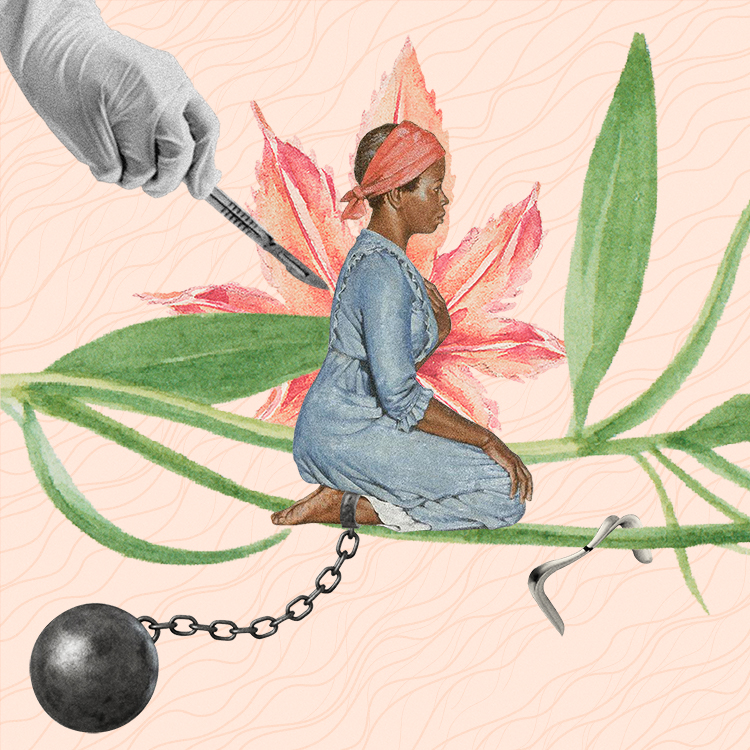
Slavery: The Original Fight for Reproductive Control
- Anarcha, Betsy, Lucy and at least nine other unidentified enslaved women and girls worked together for Dr. James Marion Sims also known as the “Father of Gynecology.”
- Sims regularly performed forced surgeries, without anesthesia, on these enslaved women under the guise of science.
- This medical terrorism was used to justify racist assumptions about the Black women and their bodies. Followers of his work embraced notions that Black women had a higher tolerance for pain when receiving medical treatment, while ignoring that these women were forcibly restrained under threat of death for these procedures. Such stereotypes have informed contemporary medical racism.

Eradication by Any Means Necessary
- Eugenics, or the racist pseudoscience that believes marginalized people could be eradicated through planned reproduction, began to influence much of U.S. policy. President Theodore Roosevelt endorsed eugenic steralization and even made it a fixture of his agenda by urging white Americans to avoid the dangers of “race suicide” by producing large families.
- At the same time, the Black population in the South was limited by poverty in a post-Emancipation era. As a result, fertility rates of Black women declined by one-third, due primarily to poor nutrition and decreased life expectancy. But Eugenicists weren’t satisfied, they sought to speed up the decline.
- By 1907, Indiana became the first state to establish medical institutions whose primary goal was to sterilize women without their consent. Criminals, “imbeciles” whose conditions were often not backed by science or confirmed by doctors—poor people and Black women were hit hardest.
- Within six years, eleven additional states had enacted involuntary sterilization laws & twenty-four states enacted laws forbidding marriage by people considered genetically defective.
Blaming the breakdown of the Black family on Black women
- Senator Daniel Patrick Moynihan wrote the Moynihan report, also known as “The Negro Family: The Case for National Action.” The report justified racial class inequality and described single motherhood or female-headed families, and out-of-wedlock births as the primary cause of Black poverty and barrier to attaining racial equality.
- Moynihan’s determinations continue to have support. His views are often touted by Conservative political pundits to dismiss blatant injustices against Black communities as the result of family structure, not exploitation and oppression.
Forced Sterilizations become routine practice
- The U.S. government began to sponsor programs that not only encouraged Black women to use birth control but also coerced them into being sterilized.
- Sterilization became the most rapidly growing form of birth control in the U.S., rising from 200,000 cases in 1970 to over 700,000 in 1980. Teaching hospitals across the South routinely performed unnecessary hysterectomies on poor Black women for medical practice. It became so popular that it was commonly referred to as “Mississippi Appendectomies.”
- In June 1973, Minnie Lee and Mary Alice Relf, were just 12 and 14 years old when they were sterilized without their consent under the federally funded Montgomery Community Action Agency constructed the program. It was later uncovered that 100,000 -150,000 poor women, almost half were Black, like the Relf sisters were similarly sterilized through the use of an experimental long acting contraceptive which were often referred to as hormonal injections.
“Problem” pregnancies are criminal offenses
- “Crack babies” became a term to legitimize a siege on Black pregnant women and the draconian measures that followed -- hospitals began drug testing pregnant women and newborns, reporting mothers to law enforcement who had trained nurses to protect evidence, thus deputizing medical professionals based on their assumptions about an individual woman’s choices.
- Between 1985 and 1995 at least two hundred women in the thirty states were charged a range of crimes based on pregnancy and drug use.

Waging War Against Black Families
- In 1996, Congress replaced the New Deal-era Aid to Families with Dependent Children (AFDC) with a new program called Temporary Assistance for Needy Families (TANF), under the guise of “ending welfare as we know it.”
- Although the majority of welfare recipients were white, politicians and media alike used gross stereotypes to pathologize Black women as the primary beneficiaries of the welfare state. As a result, states would cap the limit of children women could have to secure benefits, subsequently denying many many families income they needed to survive.

No Dignity for Mothers Giving Birth in Prison
- As of 2020, there were 1.2 million women under the supervision of the criminal justice system. ¾ of incarcerated women are of childbearing age, between 18 and 44 years. More than 60% of women in state prisons have a child under the age of 18, and most of these women are mothers or primary caregivers of their families. Yet, no required standards for reproductive, prenatal or pregnancy care in prisons exist.
- Gender-specific data on the status of incarcerated women and girls and their access to reproductive healthcare and justice is scarce. First-hand accounts help to paint a fuller picture of the quality of care incarcerated women receive behind bars when pregnant including:
- Dismissal of complaints of extreme pain
- Lack of examination during incarceration period
- Strip searching
- Shackling to bed during birth
- Practice persists despite bans
- Lack of treatment for treatable infections that can directly result in the loss of a fetus
- Extreme hunger, withholding healthy food, inadequate or spoiled food
- Long, immobile wait periods while waiting to be seen by doctors, threatened discipline for non-compliance
Black women still face punishment for pregnancy decisions
- There are more than 1,200 documented cases of women, disproportionately Black and working class women, being penalized by the criminal legal system for pregnancy outcomes
- Today, 29 states have feticide homicide laws that can be used to charge a mother for pregnancy outcomes, whether those outcomes are the result of addiction or an accidental fall down the stairs. The result is that women already suffering from addiction, mental health disorders or trauma from abuse that result in the death of their child can be charged with murder. And while these arrests and prosecutions are happening across the nation, low-income Black women in the South are most likely targeted and charged.
- The result is that women already suffering from addiction, mental health disorders or trauma from abuse that result in the death of their child can be charged with murder. And while these arrests and prosecutions are happening across the nation, low-income Black women in the South are most likely targeted and charged.
(REPRO)cussions for Black Women
- The BIG UGLY BILL includes rules that would make it harder to get abortion, birth control, and gender-affirming care.
- It keeps the Hyde Amendment, which blocks Medicaid from covering most abortions.
- It keeps the Weldon Amendment, allowing employers or providers to refuse to offer or cover abortion services.
- It limits Title X funding, restricting what family-planning providers can say about abortion or where they can refer patients.
- It cuts funding for clinics that offer abortions, putting many community health centers at risk of closing.
- It bans Medicaid and federal funds for gender-affirming care and reduces protections for trans students.
How this Impact YOU: THE STATS
- 35% of women ages 15–49 covered by Medicaid live in states where abortion is legal but Medicaid won’t cover it (except under Hyde’s narrow exceptions).
- In states where Medicaid can cover abortion, 71% of patients pay $0 out of pocket — compared to just 10% in states with Hyde restrictions.
- 60% of Planned Parenthood patients rely on public programs like Medicaid — meaning Hyde directly blocks access for millions.
- These restrictions hit low-income women and Black women the hardest, reducing access not only to abortion, but to birth control, STI testing, and prenatal care.
How this Impact YOU: The Result
- Black women already face the highest maternal death rates in the U.S.
- In 2022, 49.5 Black women died per 100,000 live births — more than 2.5× the rate for White women.
- The CDC is clear: Black women are three times more likely to die from pregnancy-related causes than White women.
Why This Matters
Our reconciliation and reproductive justice work is deeply connected to this fight.
Stories from Liberated Bodies town halls and videos show real experiences, helping mobilize communities right now.
The Black Maternal Health Caucus’ Momnibus package invests in:
- Social determinants of health
- Workforce diversification
- Community-based support
Meanwhile, the FY26 appropriations rollbacks and Hyde-related restrictions threaten these critical gains, deepening a crisis that already costs Black women their lives.
The bottom line:
We need policies like the Black Maternal Health Momnibus to protect access, save lives, and advance equity.
Get Involved
Take action today to protect reproductive freedom and maternal justice:
- Share this page and the data with your networks.
- Sign Color Of Change’s petition to show your support
- Oppose Hyde/Weldon expansions and Title X gag language
- Support Black Maternal Health Momnibus funding priorities
Every action counts, your voice can help protect access, save lives, and advance equity.
Slavery: The Original Fight for Reproductive Control
- Anarcha, Betsy, Lucy and at least nine other unidentified enslaved women and girls worked together for Dr. James Marion Sims also known as the “Father of Gynecology.”
- Sims regularly performed forced surgeries, without anesthesia, on these enslaved women under the guise of science.
- This medical terrorism was used to justify racist assumptions about the Black women and their bodies. Followers of his work embraced notions that Black women had a higher tolerance for pain when receiving medical treatment, while ignoring that these women were forcibly restrained under threat of death for these procedures. Such stereotypes have informed contemporary medical racism.
Eradication by Any Means Necessary
- Eugenics, or the racist pseudoscience that believes marginalized people could be eradicated through planned reproduction, began to influence much of U.S. policy. President Theodore Roosevelt endorsed eugenic steralization and even made it a fixture of his agenda by urging white Americans to avoid the dangers of “race suicide” by producing large families.
- At the same time, the Black population in the South was limited by poverty in a post-Emancipation era. As a result, fertility rates of Black women declined by one-third, due primarily to poor nutrition and decreased life expectancy. But Eugenicists weren’t satisfied, they sought to speed up the decline.
- By 1907, Indiana became the first state to establish medical institutions whose primary goal was to sterilize women without their consent. Criminals, “imbeciles” whose conditions were often not backed by science or confirmed by doctors—poor people and Black women were hit hardest.
- Within six years, eleven additional states had enacted involuntary sterilization laws & twenty-four states enacted laws forbidding marriage by people considered genetically defective.
Waging War Against Black Families
- In 1996, Congress replaced the New Deal-era Aid to Families with Dependent Children (AFDC) with a new program called Temporary Assistance for Needy Families (TANF), under the guise of “ending welfare as we know it.”
- Although the majority of welfare recipients were white, politicians and media alike used gross stereotypes to pathologize Black women as the primary beneficiaries of the welfare state. As a result, states would cap the limit of children women could have to secure benefits, subsequently denying many many families income they needed to survive.
Blaming the breakdown of the Black family on Black women
- Senator Daniel Patrick Moynihan wrote the Moynihan report, also known as “The Negro Family: The Case for National Action.” The report justified racial class inequality and described single motherhood or female-headed families, and out-of-wedlock births as the primary cause of Black poverty and barrier to attaining racial equality.
- Moynihan’s determinations continue to have support. His views are often touted by Conservative political pundits to dismiss blatant injustices against Black communities as the result of family structure, not exploitation and oppression.
Forced Sterilizations become routine practice
- The U.S. government began to sponsor programs that not only encouraged Black women to use birth control but also coerced them into being sterilized.
- Sterilization became the most rapidly growing form of birth control in the U.S., rising from 200,000 cases in 1970 to over 700,000 in 1980. Teaching hospitals across the South routinely performed unnecessary hysterectomies on poor Black women for medical practice. It became so popular that it was commonly referred to as “Mississippi Appendectomies.”
- In June 1973, Minnie Lee and Mary Alice Relf, were just 12 and 14 years old when they were sterilized without their consent under the federally funded Montgomery Community Action Agency constructed the program. It was later uncovered that 100,000 -150,000 poor women, almost half were Black, like the Relf sisters were similarly sterilized through the use of an experimental long acting contraceptive which were often referred to as hormonal injections.
“Problem” pregnancies are criminal offenses
- “Crack babies” became a term to legitimize a siege on Black pregnant women and the draconian measures that followed -- hospitals began drug testing pregnant women and newborns, reporting mothers to law enforcement who had trained nurses to protect evidence, thus deputizing medical professionals based on their assumptions about an individual woman’s choices.
- Between 1985 and 1995 at least two hundred women in the thirty states were charged a range of crimes based on pregnancy and drug use.
No Dignity for Mothers Giving Birth in Prison
- As of 2020, there were 1.2 million women under the supervision of the criminal justice system. ¾ of incarcerated women are of childbearing age, between 18 and 44 years. More than 60% of women in state prisons have a child under the age of 18, and most of these women are mothers or primary caregivers of their families. Yet, no required standards for reproductive, prenatal or pregnancy care in prisons exist.
- Gender-specific data on the status of incarcerated women and girls and their access to reproductive healthcare and justice is scarce. First-hand accounts help to paint a fuller picture of the quality of care incarcerated women receive behind bars when pregnant including:
- Dismissal of complaints of extreme pain
- Lack of examination during incarceration period
- Strip searching
- Shackling to bed during birth
- Practice persists despite bans
- Lack of treatment for treatable infections that can directly result in the loss of a fetus
- Extreme hunger, withholding healthy food, inadequate or spoiled food
- Long, immobile wait periods while waiting to be seen by doctors, threatened discipline for non-compliance
Black women still face punishment for pregnancy decisions
- There are more than 1,200 documented cases of women, disproportionately Black and working class women, being penalized by the criminal legal system for pregnancy outcomes
- Today, 29 states have feticide homicide laws that can be used to charge a mother for pregnancy outcomes, whether those outcomes are the result of addiction or an accidental fall down the stairs. The result is that women already suffering from addiction, mental health disorders or trauma from abuse that result in the death of their child can be charged with murder. And while these arrests and prosecutions are happening across the nation, low-income Black women in the South are most likely targeted and charged.
- The result is that women already suffering from addiction, mental health disorders or trauma from abuse that result in the death of their child can be charged with murder. And while these arrests and prosecutions are happening across the nation, low-income Black women in the South are most likely targeted and charged.
(REPRO)cussions for Black Women
- The BIG UGLY BILL includes rules that would make it harder to get abortion, birth control, and gender-affirming care.
- It keeps the Hyde Amendment, which blocks Medicaid from covering most abortions.
- It keeps the Weldon Amendment, allowing employers or providers to refuse to offer or cover abortion services.
- It limits Title X funding, restricting what family-planning providers can say about abortion or where they can refer patients.
- It cuts funding for clinics that offer abortions, putting many community health centers at risk of closing.
- It bans Medicaid and federal funds for gender-affirming care and reduces protections for trans students.
How this Impact YOU: THE STATS
- 35% of women ages 15–49 covered by Medicaid live in states where abortion is legal but Medicaid won’t cover it (except under Hyde’s narrow exceptions).
- In states where Medicaid can cover abortion, 71% of patients pay $0 out of pocket — compared to just 10% in states with Hyde restrictions.
- 60% of Planned Parenthood patients rely on public programs like Medicaid — meaning Hyde directly blocks access for millions.
- These restrictions hit low-income women and Black women the hardest, reducing access not only to abortion, but to birth control, STI testing, and prenatal care.
How this Impact YOU: The Result
- Black women already face the highest maternal death rates in the U.S.
- In 2022, 49.5 Black women died per 100,000 live births — more than 2.5× the rate for White women.
- The CDC is clear: Black women are three times more likely to die from pregnancy-related causes than White women.
Why This Matters
Our reconciliation and reproductive justice work is deeply connected to this fight.
Stories from Liberated Bodies town halls and videos show real experiences, helping mobilize communities right now.
The Black Maternal Health Caucus’ Momnibus package invests in:
- Social determinants of health
- Workforce diversification
- Community-based support
Meanwhile, the FY26 appropriations rollbacks and Hyde-related restrictions threaten these critical gains, deepening a crisis that already costs Black women their lives.
The bottom line:
We need policies like the Black Maternal Health Momnibus to protect access, save lives, and advance equity.
Get Involved
Take action today to protect reproductive freedom and maternal justice:
- Share this page and the data with your networks.
- Sign Color Of Change’s petition to show your support
- Oppose Hyde/Weldon expansions and Title X gag language
- Support Black Maternal Health Momnibus funding priorities
Every action counts, your voice can help protect access, save lives, and advance equity.

OUR MISSION
Prosecutors across the country have power to say NO to criminalizing pregnancy. Elected officials have power to say NO to more bans and barriers and instead invest in maternal health reproductive freedom, and family care.
That’s why we must call on them to prioritize internal policies that are rooted in Reproductive Justice and resources that institute an anti-racist, anti-classist, community-based and holistic model of health care.
In Their own Words
Stories of Liberation
Hear tales of strength, resilience, and dignity from five Black abortion storytellers who refuse to have their voices silenced.





Your Voice
Share Your Story
Record a YourVoice Video sharing your story or solidarity on this issue.
Resources
- Jackson, Mississippi Digital Resource Guide
- All* Above All, “All* Above All Reacts to FY26 House Labor HHS Appropriations Bill,” Sept 3, 2025.
- Black Maternal Health Caucus,The Momnibus Act.
- CDC, Maternal Mortality Rates (2022 PDF, 2023 data).
- KFF, “The Hyde Amendment and Coverage for Abortion Services.”
- Guttmacher Institute, Hyde background.
- House Appropriations Committee press release on FY26 Labor-HHS.
- Guttmacher Institute. 2023. State Funding for Abortion Under Medicaid.
- Planned Parenthood. 2024. The History of Planned Parenthood. https://www.plannedparenthood.org/about-us/who-we-are/our-history.
- Heritage Foundation. 2023. Project 2025: A Presidential Transition Project. https://www.project2025.org/.
- Bryant, A. G., and Swartz, J. J. 2018. Why crisis pregnancy centers are legal but unethical. AMA Journal of Ethics 20(3), 269-277.
- https://journalofethics.ama-assn.org/article/why-crisis-pregnancy-centers-are-legal-unethical/2018-03.
- Legal Information Institute. 1980. Patricia R. Harris v. Cora McRae, et al. https://www.law.cornell.edu/supremecourt/text/448/297.
- Upadhyay, U. D. 2022. Trends In Self-Pay Charges and Insurance Acceptance for Abortion in the United States, 2017-20. Health Affairs
- 41(4), 507-515. https://www.healthaffairs.org/doi/10.1377/hlthaff.2021.01528.
- USA Facts. 2023. Three Charts on Diversity in the Federal Government’s Workforce. https://usafacts.org/articles/three-charts-on-
- diversity-in-the-federal-governments-workforce/.
- Salganicoff, A., Sobel, L., Gomez, H., and Ramaswamy, A. 2024. The Hyde Amendment and Coverage for Abortion Services Under
- Medicaid in the Post-Roe Era. https://www.kff.org/womens-health-policy/issue-brief/the-hyde-amendment-and-coverage-for-abortion-
- services-under-medicaid-in-the-post-roe-era/.
- Planned Parenthood. 2024. Federal and State Bans and Restrictions on Abortion (Hyde Amendment). Planned Parenthood Action
- Fund. https://www.plannedparenthoodaction.org/issues/abortion/federal-and-state-bans-and-restrictions-abortion/hyde-amendment.
- Boonstra, H. D. 2016. Abortion in the Lives of Women Struggling Financially: Why Insurance Coverage Matters. Guttmacher Policy
- Review 19(6). https://www.guttmacher.org/gpr/2016/07/abortion-lives-women-struggling-financially-why-insurance-coverage-matters.
- Gallup. “Abortion Trends by Age.” https://news.gallup.com/poll/246206/abortion-trends-age.aspx.
- U.S. Office of Minority Health, Infant mortality and Black/African Americans.